Forty-four minus ten

In ten days I will celebrate the 44th anniversary of my birth.

Until that day, I will post one birthday memory a day. Hey, it’s my blog; I’ll talk about myself if I want. Isn’t that the point of blogging?

Today I will talk about the general calendrical position of my birthday.

It kinda sucks.

Oh, you wanted more than that? OK…

I remember being very young when I realized that, date-wise, I got screwed on the whole birthday thing. It only took a month or two of kindergarten, and having classmates get to celebrate their own birthdays in class, with cake and presents, to show me that I would likely never get to share in that experience. My birthday, for all the years I went to school, fell exactly three days after Christmas Day, and three days before New Year’s Eve – smack-dab in the midst of Christmas Break.

And, of course, with Christmas being the 800-pound gorilla of holidays and gift-giving, I’m sure that my parents felt some pressure to not celebrate my birthday as much as, say, my sister’s birthday, which was in November. We’re already socialized to give lots and lots of presents for Christmas; my parents must have faced the pressure to just hold back some for me and save them for three days later. In fact, when I tell people when my birthday is, that’s a common reaction: “Oh, you probably got fewer presents for your birthday, right?”

As common as that idea is, I scour my memory and, other than the hole caused by a lack of social sharing by having a party with friends, I did not lack for birthday presents. My dad said once to me, as an adult, that they both saw the potential unfairness and worked to avoid it.

I have sometimes joked that I should celebrate my half-birthday, on June 28th. A summer time birthday would be easier to ’round up folks to celebrate with me, and people might be more likely to purchase gifts.

But after forty-four years, old habits are hard to break. My birthday is the 28th day of the 12th month of the year, and will always be.

(Hat tip and huge thanks to Tracy, my best friend in the world, for this idea!)

Rights and responsibilities

Robert Anson Heinlein wrote (in “Starship Troopers”, I believe) that rights come with responsibilities. He was a crazy ol’ libertarian, but I like the idea that people have to consider proper use of their inalienable rights and not just go exercising them at will.

Which is a long-winded way for me to link to the letter that an executive vice-president of the National Geographic Society wrote to the publisher of the Portland Mercury.

The letter addresses the “borrowing” of the look of National Geographic magazine for the local paper a few weeks back, right down to the familiar yellow border. The Merc’s editor, Wm. Stephen Humphrey, saw the letter and figured the local paper was in for a lawsuit.

Turns out, no lawsuit.

Seems that the folks at National Geographic are advanced lifeforms, and realize that copyright laws aren’t there to squelch all forms of creativity – like parody, for example:

Dear Editor Humphrey:

Your October 30, 2008 edition of Mercury Geographic has been brought to our attention. I hope you are not surprised as National Geographic has a 120-year-old record and responsibility to cover the world and everything that is in it.

Our first instinct in such circumstances is to issue a cease-and-desist letter to prevent any unauthorized use of our valued trademarks and trade dress, as well as various copyrighted material.

We recognize, however, that imitation is the sincerest form of flattery and that your mimic of our recognized look for your “Halloween Dress-Up Issue” was not malicious appropriation, but in good fun.

The letter then devolves into a tit-for-tat sales pitch for the Mercury to encourage their readers to resubscribe to the National Geographic, which Humphreys faithfully does in the above-linked blog post.

Awesome. So much better than going in with lawyers blazing, isn’t it? They had a right to their trademark… and they exercised it thoughtfully. One might even say, “responsibly”. Good for them!

I really want to make a connection between the stereotypical “naked native boobies” found in old Nat’l Geos and the porn ads in the back of the Merc, but the exact connection escapes me.

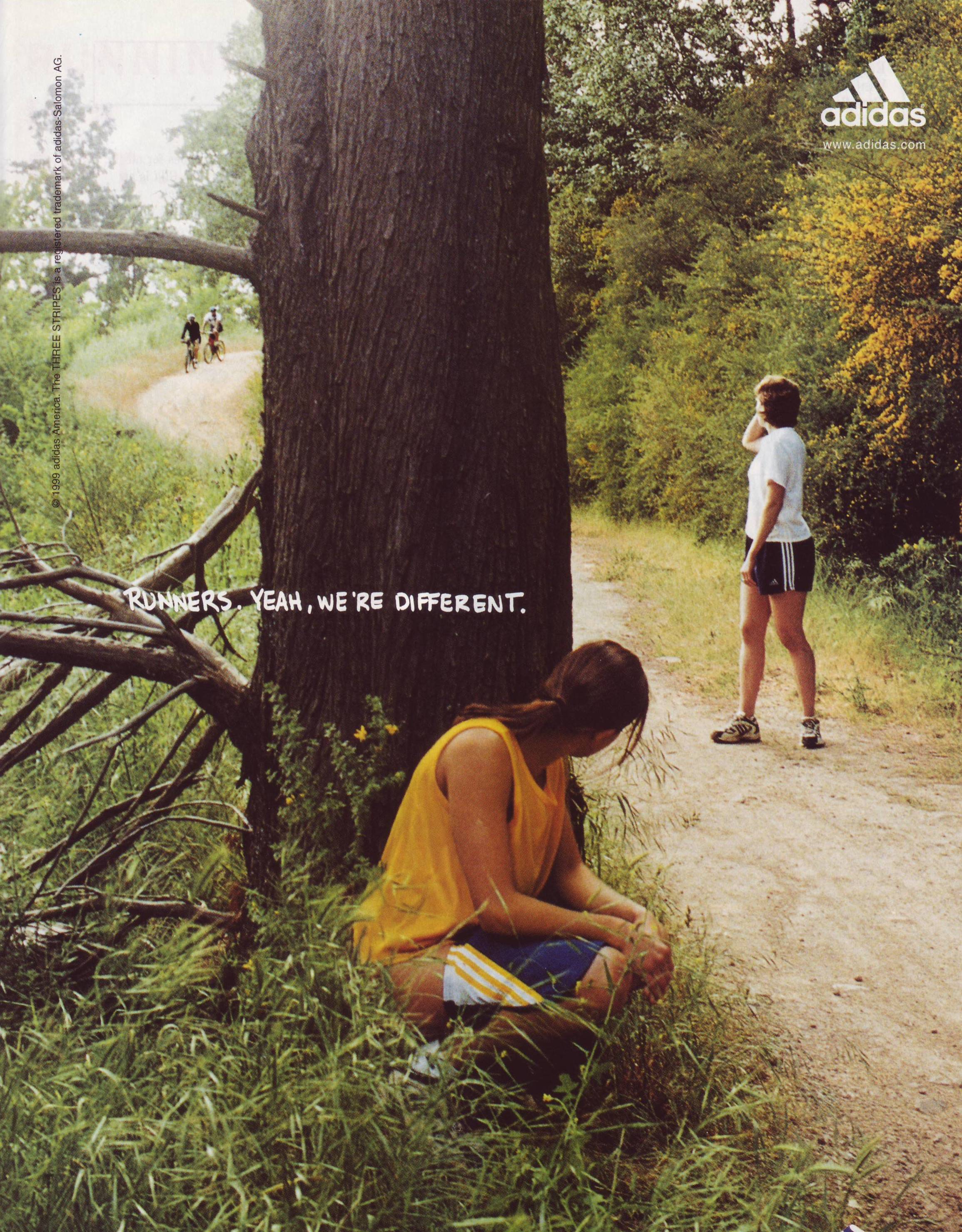
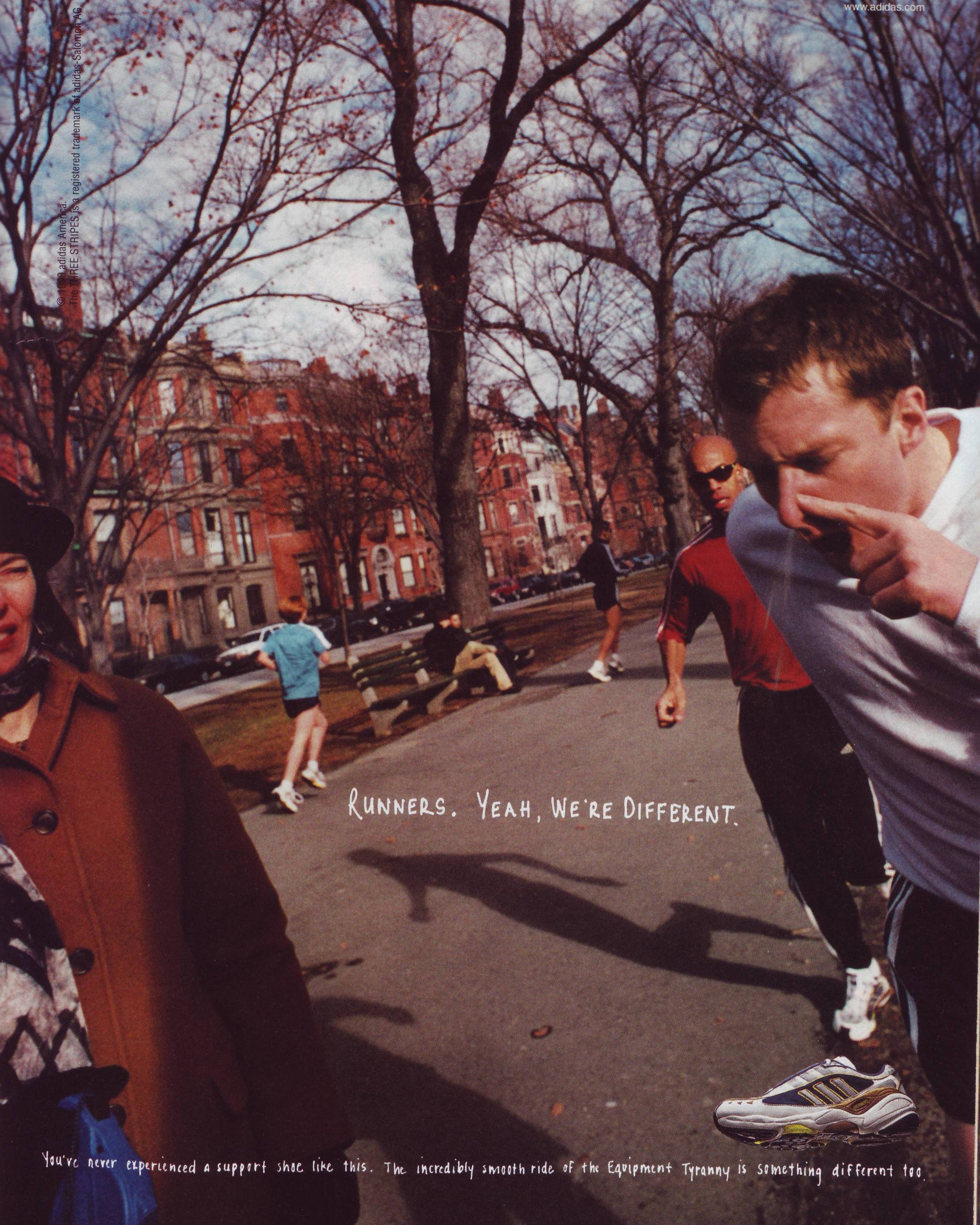
Runners ARE different

Hat tip to Kelly Johnson over at OregonLive for this decade-old Adidas ad campaign for their running shoes/clothes.

Each ad touches on some aspect of running that runners “get” and non-runners, probably, don’t.

Of the eleven acts depicted, I have done some variation of eight of them. Yes, even this and this, I’m not-really-ashamed to say. Feel free to guess the other seven in the comments, or just speculate about my mental health. Or even chime in if you’re a runner. It’s all good.

(Cross-posted from my normally-all-about-running blog)

Limelight

From a couple of months ago, comes the following post. Started, and not finished.

*****
A cold, rainy day, and a long work week, and being low on money, and not exercising, and feeling alone.

I needed… comfort food.

Yeah, I sought to fill the hole created by things both in my power to change and things outside my ability to change… with food.

I’d hoped to, at least, choose wisely, something low calorie. I just didn’t want to have a simple sandwich at home.

So I went to the Limelight.

My favorite waitress waved when I walked in. She came over, and sat with me and chatted a bit. She was tired, she said. “I’ve been out late every night this week.” She had started school just weeks before, but instead had been drinking and not sleeping.

It felt like there was more she wanted to say… but for whatever reason, didn’t say it. She took my order (Sante Fe chicken sandwich with spicy sauce, jack cheese and grilled jalepeños and the soup of the day)

Phone call

2 December 2006

My phone rings. I pick up.

“Hi, Dad.”

“Oh, hi, son. Listen, two things. First, are you going to Max’s birthday thing tomorrow?”

“Yeah, at some point.”

“Oh, OK, good. Second, are you going to New York for Christmas?”

“Yes, I am.”

“What airline are you flying?”

“Alaska.”

“Oh, great. Do you mind if I ask you what kind of deal you got?”

“I had enough frequent flyer miles to cover a round-trip ticket. I had to use a lot, because of when I was going, but I still have a bunch left over.”

“Oh, nice. When are you going?”

“I fly out the 22nd, and I’m coming back on New Year’s Day.”

“Oh, so you’ll be there for your birthday?”

“Yeah. Are you going to go?”

“Well, I’ve been thinking about it. Since everyone’s going to be there, I’ve been trying to find a deal. It’s hard because of all the black-out days.”

“Right. That’s why I had to use so many frequent-flyer miles. Forty thousand.”

“Wow.”

“Yeah, but it’s all covered., so that’s nice.”

“Yeah.”

“Yeah.”

“Well, I was thinking. Since everyone’s going to be there, you know, I was just thinking that it might be nice to come out for just a few days, maybe, and get a car… and drive down to [my hometown], in Jersey. The old homestead is still there, I can see it in Google Earth.”

“Wow. I’d… love that, dad.”

“Really?”

“Yeah.”

“Well, don’t tell anyone. Don’t tell your sister about it. I’m trying to work out a deal.”

“OK.”

“Carol is running hot and cold on the idea, but maybe if I can get a deal…”

“Right, dad.”

“OK. See you tomorrow, son.”

“Bye, dad.”

Freedom of speech applies to idiots, too, sadly

I believe in free speech. I believe in it a lot. It’s something that still exists to a large degree in my home country (the United States of America), although there are times when I get really worried about it, like whenever anyone makes the dishonest argument that censorship (real censorship – using governmental force to stifle free speech) is necessary “for the children!”

Neil Gaiman had an excellent essay outlining why he believes it’s necessary to defend speech that he, personally, considers “icky”. It’s obviously worth a read, but if I could condense the argument down to just a paragraph or two it would be the following:

“The Law is a blunt instrument. It’s not a scalpel. It’s a club. If there is something you consider indefensible, and there is something you consider defensible, and the same laws can take them both out, you are going to find yourself defending the indefensible.”

Mr. Gaiman also explains that there is a difference between making lines on paper, and taking actions that actually cause harm to children, and that is indeed a huge difference. He’s making the above argument in the context of defending comic book writers and artists to depict things on paper that would, if they involved actual living humans, be clearly pornography – and if adults were participating or recording said acts, would clearly be abuse. But drawings? Words on a page? To Mr. Gaiman, the drawings and words may make him, personally, uncomfortable, but he would defend the right of the artist or writer to make them, because if those are forbidden, then who knows what future art Mr. Gaiman wants to make would be forbidden?

To be clear, I agree with Mr. Gaiman. I am, personally, loathe to put any restrictions on speech and art at all, even art depicting things I do not agree with. I mean, obviously I do: The Old and New Testament depict such horrors as selling one’s daughter into slavery or giving her up for rape, wholesale religiously-motivated destruction of entire towns and nations, intense torture, bigotry and racism, even strict prohibitions against eating delicious lobster or barbecued pork ribs… Mmmmmm. And yet, despite these barbaric stories, there are people out there who would look you in the eye and, un-ironically, call the collection “The Good Book”.

Ugh. I disagree, but I will defend the right of that book to exist and for adults to read it.*

But bringing it back to speech, and whether or not humans are free to engage in it, in my wanderings on the internets I came across this story of a couple in Holland Township, New Jersey who have given their children… unusual names:

“JoyceLynn Aryan Nation Campbell, Honszlynn Hinler Jeannie Campbell and Adolf Hitler Campbell.

Good names for a trio of toddlers? Heath and Deborah Campbell think so. The Holland Township couple has picked those names and the oldest child, Adolf Hitler Campbell, turns 3 today.”

o…k.

Seriously? The youngest is named Adolph Hitler Campbell?

How’s that for a not-very-subtle act of rebellion against the dominant paradigm? Are they exercising their right of free speech, or are they taking an action that will result in the abuse of a child?

Johnny Cash had a song about a boy named “Sue” by an absent father, who had good intentions, twisted though they were. Once the parent’s point of view was explained, everyone had a good laugh and agreed the outcome justified the pain. Makes for a nice song.

The above linked article coyly does not delve into the motivations that the Campbells had for choosing their children’s names, but instead posts a question about it for the readers, and links to a gallery of images from the Campbell’s home – including swastika tattoos, Nazi flags and decorations, and an adorable picture of the little towheaded boy.

I think the reporters (the byline is credited to “Express-Times staff” – no one reporter is willing to take credit for this) are hoping readers will draw their own conclusions.

The problem, the conflict in the article, is that the Campbells have been turned down by a local bakery to make a cake with the 3-year-old’s name on it, and the Campbells claim to be confused by this.

I’m unsettled by this, to say the least. Clearly, the Campbells have the right to name their children anything they want. Clearly, they have the right to celebrate whatever culture they wish – even a culture that has become synonymous with evil. They have broken no law, and I wouldn’t even go as far as to say that they’re unethical or immoral in their own, personal, adult choices. Except that anyone with a brain and a thimbleful of understanding of human nature would see that they are inflicting social and psychological abuse on their children.

And in that exception, by taking that step of naming their children, the Campbells are very, very wrong indeed.

_____
* Carrying out its bizarre proscriptions and forcing them on others, especially children too young to know any better… well, that’s where I draw the line, at least in the context of public discourse. I know I’m the minority opinion here but there’s a growing number of folks who agree.

Acting!

This post was originally started in February 2007. The part in brackets, where I gave myself notes on the dream I was describing, are now as inscrutable to me as they likely are to anyone else. I have no memory or feeling about the words I wrote down almost 2 years ago. But the rest of the post, about dreams and dreaming in general, is still interesting to me.

Enjoy.

*****
Not everyone dreams – or, perhaps more accurately, remembers their dreams. Scientists can demonstrate that anyone they test shows the same level of brain activity during sleep, but after the subjects wake up and pull the little sticky tabs and wires from their bodies and skulls, not all of them report images, feelings and other dream-like memories.

I almost always remember my dreams. In fact, when I was in my teens, a friend and I heard about lucid dreaming, which was apparently a state of dreaming where one is aware of the fact that they are dreaming, if you can imagine such a thing. It sounded like the best fantasy playground ever, where one would experience what it would be like to be truly limited only by one’s own imagination.

In point of fact, in all my attempts, I only managed to experience a few brief moments of dreaming lucidity, and those moments, where I took the reins of my powers of thought, remain etched in my mind as if they were actual, living experiences. The reason I bring all this up now is simply as a preface to the idea that I have somehow exercised my “dream muscle” to the point where I can be considered an elite dreaming athlete.

Our dreams are normally full of images and feelings taken from our waking life and given new juxtapositions, they form patterns, both familiar and new, and examining them can reveal much insight into how we are dealing with the world. But the way in which the symbols are brought to our conscious awareness seem to be shaped by the amount of creativity we experience when conscious – or so I believe, with my layman’s understanding of the brain.

My dreams, lately, have taken on an even stranger tone, in fact. But do not be alarmed. I think they’ve just been infused with greater and greater levels of creativity.

[roller-blading at the airport; Ken in a pinstriped suit; Clinton on TV in same suit]

[picking out a red bottle from the bread carts; acting as Brian acting as someone else; going to find my friend and co-worker; in an IT department for a store of some kind; new second-in-command manager with hair growing out of her face; wanting to do anything she can to help me find my place; referring other friends who may be lost, too – including ACTUAL Brian; “that’s funny – they wanted to be sure I talked to you, too!”]

“Milk”

In my quest to see all the Oscar-nominated Best Films of 2008 prior to the nominations being announced next year, using only my well-tuned sense of what constitutes an Oscar-nominee, I went to see “Milk” yesterday, Gus van Sant’s biopic of San Francisco City Supervisor Harvey Milk, a gay activist who was (spoiler alert!) shot and killed by fellow City Supervisor Dan White.

Sean Penn did what he always does – completely disappear into the role and make him a real person, with all our flawed perceptions and amazing insights. More than that, though, Penn’s performance shows a character that always pushed forward, and maintained a positive outlook, no matter what obstacles stood in his way.

The movie, seen through a wanna-be activist’s eyes (mine), also shows how movements were built back in the day. Milk actually tried to get the political support of Dan White – of course, not knowing what White would do in the future, which we now know – by trying to find some common ground. Of course, White’s idea of common ground appeared to be either too radical for Milk to support (something about psychiatric tests for children? I was never really sure), or that was another example of Milk’s flaw, that he never took the time to look into the issue to find some way he could support White’s side. Milk wanted his gay rights proposal to pass the city council with a unanimous vote as a symbolic measure, but when he failed to get White’s support he pressed ahead anyway, then, flush from his victory, approached White again. This time, White had a politically unreasonable request – he wanted Milk to introduce a pay raise for City Supervisors, which Milk didn’t even consider supporting.

Milk fought against a California state initiative, Proposition 6, which would have banned not only gays from teaching in public schools, but would have also gone further to ban anyone who supported gays. The state legislator who lead the drive for that measure is shown in the movie explaining that there were tests of some sort built into the bill. Milk has a meeting with the gay rights leaders in California at that time, and Milk denounces the pamphlets that they are distributing to fight against the measure: the text does not mention the word “gay”, and does not put a human face on the problem, instead taking a “high road” and framing the whole debate in terms of human rights.

Milk urges his friends and followers to come out. His thought was that if more people were aware that someone they knew was gay, they would vote against the bill.

The movie suggests that the reason Prop. 6 lost was because of the courageous approach taken by Harvey Milk and the opposition. Because of the lead time for making movies, the writer and filmmakers had no idea, I’m sure, that the fight in the film would mirror the fight this year in regards to Prop. 8. Sadly, mirror is the right word – thousands of families were torn apart, a right enshrined in the California Constitution taken away because of those who mis-read and mis-understand the stories told by long-dead men, when Prop. 8 passed this year.

As I said, I watched the movie while wearing my activist hat. The struggle for gay rights, which is still in dispute thanks to the misreading of a Bronze Age text by its present-day followers, reminds me of the similarities to the atheist community. We atheists have only begun to collect in groups and to announce our presence to the world at large. On a national level, there is only one elected representative who calls himself a humanist, Rep. Pete Stark (D-CA13), and even Mr. Stark didn’t announce he was a humanist until after he’d been elected. I have no particular insight into Mr. Stark’s personal beliefs, and I mean no disrespect, but to my ears, “humanist” sounds like a cop-out for someone who can’t go the whole distance and call themselves an atheist. And if that is the case, then the reason it’s not a tenable label for an elected official is because of the vast influence that the followers of gods have in our supposedly modern society.

Earlier this year, the Secular Coalition tried to find as many atheist elected officials as they could. They released a survey. From the US President, to Congress, down to the state and local levels, there are over a million men and women elected to office.

The Secular Coalition found five; The afore-mentioned Rep. Stark; Nebraska State Senator Ernie Chambers (I am guessing, since Sen. Chambers was first elected in 1971 and is Nebraska’s longest-serving legislator, that he did not come out as an atheist in his primary campaign); and three at the local level, one in Berkeley, California, one in Franklin, Maine, and one from Arlington, Massachusetts.

Harvey Milk’s idea of making the fight personal by putting a face on what is otherwise an abstract idea is a good one. And the goal of getting more atheists elected into office is also a great route to take. The atheist community is only now beginning to organize and speak as one group. It’s going to be a long fight, but studies show that, as education rises, so does non-belief. Education doesn’t just mean advanced degrees; it can also mean just talking to your neighbor or friend.

Our elected officials are, by and large, experienced and well-educated, in most cases upper middle class or better. And yet there are only five out atheists among them? Far more, I think, are in the closet, put there by fear of oppression by the outspoken religious. And yet, we all share something. Atheists are, by and large, the ones who understand that separating church and state protects the church, too. Atheists are natural allies of people with minority religious traditions.

My youngest nephew is 17, and, like me and his father, an atheist. The night Barack Obama was elected by the people to be the President of the United States of America, its first black president, I asked my nephew if we would live to see an atheist president.

He thought a moment, then said, “I probably will,” then smiled and continued, “but not you, Uncle Brian.”

It’d be nice to prove him wrong – but I suspect he’s right.

“Sometimes I think I live in a different world”

According to Nathan Rabin @ the Onion’s AV Club, the manic pixie dream girl is a movie character that:

“…exists solely in the fevered imaginations of sensitive writer-directors to teach broodingly soulful young men to embrace life and its infinite mysteries and adventures.”

The MPDG character is, in the best cases, a strong, but flawed, female; just like actual women. In the worst cases, though, they become a trope, a gimmick. Not a real, full-fledged person, but a collection of plot devices and snappy one-liners.

Artistic, sensitive boys tend to fall madly in love with them – and I don’t just mean artistic, sensitive boy movie characters. The ones in the audience do, too – not to mention the writers and directors who help put them on the screen.

Like William Miller once said of, and to, his manic pixie dream girl, “Sometimes I think I live in a different world.” It’s great, and cathartic, though, to visit her world once in a while. You’re never the same afterward.

Reading another amazing post from Grace, I think I see a flip side to the story. Grace was Christopher’s manic pixie dream girl, only she is a real, feeling, complex human being.

And she’s an amazing writer.