Arrow of God

Hearing someone praise God for his power on the evidence of a little girl surviving being hit in the throat near the carotid artery only makes me think:

If God was so powerful, couldn’t he have simply prevented the arrow from hitting her?

There’s just something not right about the logic: this little girl was struck by a deadly object in a horrific fashion but it’s OK because God allowed it happen just enough to wound her, but not kill her?

This must be the same reasoning that says torture and indefinite imprisonment of non-combatants is OK as long as there’s no permanent organ failure.

I guess that means rape is fine as long as the mom survives and has the resulting child because, hey, everyone loves babies! They’re so innocent.

Sorry to go off on a tangent. I saw the initial comment that sparked my posting on Facebook, otherwise I’d link to it. I get that the mother is relieved her child survived the arrow, but attributing just one small part of her surviving to God and using it to state that “God is powerful” is simply horseshit and doesn’t stand up to any kind of thinking at all.

But the writers of the various books of the Bible, and all the men who have spent centuries interpreting it, don’t really like thinking and reason, do they? It got in their way. Better to discourage reason and logic in favor of convoluted worship of authority; that’s how a cult is built, after all.

Worldbuilding

So… I’m in the last week before I actually start running a Dungeons & Dragons game, and I’m… worldbuilding.

Which means: drawing maps, creating characters, deciding on stories, and setting them all together, like dolls in a house, so that the other players can come over and play around in my world and, hopefully, change it for the better. And we’ll all have a great time. That’s the goal – to enjoy ourselves.

And I’ve been scurrying around, trying to make it all work and all come together, as the time ticks down to Thursday 5 PM, and I feel the press of the deadline and want to have it all done… so that the players feel like it’s a real world. At least as much as a world with Elves and Dragons and magic wands can be, anyway.

Did you see this post on IO9? Josh Friedman was the producer for the Terminator TV show (that was awesome, by the way, if you ever get a chance to watch it on DVD) and in this article he talks about “worldbuilding” and, because I’m in the middle of worldbuilding myself, it really resonates with me. Especially about how some of the world is always going to be fuzzy no matter how much work I do. It will always be bigger than I can imagine it, because it’s a freakin’ WORLD.

He says:

Which lead us to this: there will always be a point in your world-building when the world you’ve built outgrows the scope of the story you’re telling. The edges are fuzzy; the next town over is mysterious. Perhaps you’ve hinted at something which suggests something else, which would really turn things on its fucking head IF you were to go down that path BUT YOU ARE NOT.

Not now. Not yet. And possibly, never. If you’re world-building well, your world should feel full and alive and bustling in the corners, even if you’ve never actually made it over to the corner to see what the fuck is going on there. The world is true to your vision, but there is ambiguity and mystery and things undiscovered. I can know a thousand things about my the world I’ve created, but if there aren’t a thousand others just outside of my creative periphery, then I start getting a little sketchy and bored.

This is how I feel lately: every time I turn my attention to some part of my D&D campaign, there’s always something more to be decided, or detailed, or written down, or rolled up, or named. Always. No matter how much work I do, no matter how much effort I put in. There’s always going to be a part that’s overlooked.

I just want my players to feel that, no matter where they look, they see something that’s a part of the whole.

Yeah… I’m probably going to have to let go of that want. ‘Cause I barely have time enough for this world… Let alone a whole ‘nother one.

Almost like blogging

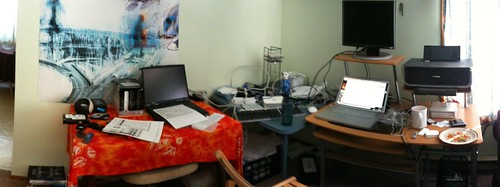
Step one: read enough positive reviews of AutoStitch (link will open in iTunes) and it’s magical panorama-creating powers that I decide to drop the $1.99 on it to purchase it.

Step two: Take a bunch of quick pictures of my computer work area with my iPhone.

Step three: Spend a few minutes tagging all the various items in the picture to explain what it all is.

My computer desk
Click picture for larger, tagged image.

Step four: Post it all here.

Hey! It’s like I’m blogging!

You’ve been hired to explore and protect a lighthouse…

I’ve been thinking about Dungeons and Dragons lately and putting together a few ideas for a campaign setting.

My sister and her husband have a beach house in Washington. It’s on the Long Beach peninsula. The little town of Ilwaco, WA, is right on the southern tip of the peninsula and right at the mouth of the Columbia River. There’s a lighthouse there, and a small sheltered cove for a fishing fleet, and a small town. To the east and north are cranberry bogs. The peninsula shelters a little bay and there’s a little village called Oysterville; at the north end of the spur of land is a marsh and wildlife refuge. And, of course, to the west is the gigantic Pacific Ocean.

I haven’t been there for a few years, but on my many visits back in the day, I’ve pondered using Ilwaco and the surrounding areas as the geography for a fantasy setting.

The lighthouse and fishing village I’d keep, but in the center of town I’d place a large cathedral/religious school. Back on the small lake I’d put a walled lord’s manor; not big enough to be a castle, just a fortified mansion. Instead of paved streets and cars there would be carts and horses; swords and bows instead of guns. A medieval technology level, with a smattering of magic.

I imagined stories about a young man who had grown up in the area and who had rejected becoming a fisherman and had fed his curiosity with the stories of visitors to the city; the young man wasn’t much of a fighter but was very sneaky, picking pockets and stealing food when he could rather than trying to earn or catch it. The young man (I had never named him) would be fascinated by the stories of the powerful men and women (and occasional elven princes and princesses and dwarven barons and baronesses and… stranger things) that came to seek help at the religious school or seek the counsel of the lord of the town. Wizards and paladins, who were once the military might of the Empire, have fallen into decline and in some areas are even feared and hunted and thought to be the cause of the dark age that has fallen; but the boy has seen some things that make him believe that the wizards and paladins are returning and that someone is trying to put the Empire back together again. For good or evil, though, he can’t yet decide.

The town was once the farthest outpost of a kingdom or empire that, centuries ago, was the most powerful political and military force in the world. But the eternal Empress had died, and her sisters and brothers, and her few sons and daughters, had not been able to decide on an heir to take the throne, so the Empire had been splintered. Some regions were overrun with wild monsters; some areas were under control of one of the families and children of the Empress; and some had reverted to local customs or been merged with the non-human races. The tiny coastal town, that I had modeled after Ilwaco, though, was self-sufficient enough to survive in roughly the same manner for a long time, and had been blessed with a string of benevolent masters and mistresses in the lord’s manor. But it was still a wilderness; there are still monsters in the bogs and wetlands.

That setting has been sitting in the back of my mind for a long time. In the last couple of days I’ve added a bit more backstory and given some thought to what the overall story of a campaign would be, and most importantly where and how it would start. The beginning characters could be fighters, thieves, clerics, wizards, rangers, human or non-human, either locals or visiting, hired by the priests or lord for a specific purpose, to protect the lighthouse or a sailing vessel or caravan on a trip inland. And I’ve got some ideas for what the first few adventures would be; the lighthouse has fallen into disrepair and needs cleaning out and guarded; monsters from the swamps are raiding the town and need to be stopped. That sort of thing.

…and, of course, the more I think about it, the more details I come up with and need to start writing it all down. The Empress’ crown, and shield, and sword, and scepter, were all magically endowed and were lost when she died; each had special powers that aided her in ruling over such a large land. Finding those items might help bring the Empire back; likewise, keeping those items out of the wrong hands could prevent a lot of suffering.

I’ve started drawing up maps and making character sketches of some important people in my setting. I still need to get a set of the rule books, though, and I’m a little lost in which edition of D&D is the best for this kind of thing, but I’m semi-settled on Edition 3.5, even though, used, those books still go for $30 or more. But the rules themselves don’t much matter, I think.

I’ve always known that Dungeon Masters are often frustrated writers. And I’ve been a frustrated writer for a long time. Maybe it’s time for me to return to a medieval fantasy setting…

500 Days of Summer (2009)

I can’t really tell you why I didn’t like 500 Days of Summer without giving away the ending. I mean, probably. So there may be spoilers in this review. In fact, I may, at one point, tell you how it ends, describe the scene to you. But without context, you may draw the wrong conclusion about what I’m describing; you won’t know for sure unless you read the whole review, spending as much time as I want to spend writing this out, only to find that you’re wrong.

If I did that to you, would you enjoy it, think that it was a surprise and a delight, worth the time? Or would you feel cheated, forced to focus on something, an event or character that ultimately proved to be nothing more than a distraction, a cipher?

And what would you think of me for having done all that? I may seem clever and charming; or I may seem mean spirited. It all depends.

There are categories of jokes like that. They’re called “shaggy dog stories”. If you don’t want to click the link, a shaggy dog story is one in which the narrator tells a long, involved story with lots of repetition and digressions, all to distract you from the horrible anti-climactic ending or, worse, the awful pun that has nothing to do with the story you’ve been made to listen to.

Some people find shaggy dog stories funny. Those people are usually the ones telling the story, or people who enjoy telling them. Often, the reaction to hearing a shaggy dog story is not laughter, but a groan, for having fallen for the setup and not seeing the punchline coming. The listener groans because they’ve been had.

Likewise, at the end of “500 Days of Summer” I felt like I’ve been had, like I’ve been made to sit through scene after scene that almost promised me character development, that gave me tantalizing glimpses of the possibility of Summer’s (played by Zooey Deschanel) having some kind of inner life or rational motivation for doing all the things that Tom (Joseph Gordon-Levitt) saw her doing to him.

Sadly, no.

Very little reason is given for Summer doing the things she is shown doing in the movie. And, worse, several times she’s shown doing the same thing in different scenes, but the second time is given different context, so the meaning of her actions are changed. There are times when this writing technique is clever and used to good affect, but trust me, this movie is not Rashômon and the director is not Kurosawa.

In fact, Summer is not a real person; the character only exists to give the needy, clingy and lack-witted Tom something against which to run the gamut of emotions from ecstasy to despair. She is a Manic Pixie Dream Girl without even the semblance of a mind or life of her own.

Worse, with all the post-modern flashbacks and scenes with more than one interpretation and fourth-wall-breaking dance numbers, the writers chose to use a freakin’ narrator. Narrators that are not identified as one of the characters in the film generally imply an omniscient viewpoint; but of course, nothing is to be trusted in this movie. Is the narrator up front? Are we to believe his descriptions of things? To the writers’ credit, they have the narrator tell us at the beginning that this is a boy-meets-girl story, but it is not a love story. To their detriment, however, they also tell us that Summer is special and amazing, without giving us much more to go on than Zooey Deschanel’s impenetrable charm and giant soulful eyes to validate that.

Seeing Summer’s hand, complete with wedding ring, resting on Tom’s hand on a park bench means nothing without context. Hearing her say things like “I’m not looking for a relationship right now” and then randomly kissing Tom in the copy room at work is the kind of story self-absorbed and emotionally-fragile men tell, not the kind of thing real living breathing women do. Tom’s view of Summer is distorted by the writers’ lack of imagination; it feels very hateful. I have no doubt that there are lots of men who will tell me that they, too, have known women like this; the “seduction community” is almost entirely made up of boys with exactly that take on women. But I am sure that the opposing stories, from the feminine side, would talk about stalk-y, grasping boys with bottomless pits of need to be filled. Or not filled.

My want for a believable set of characters, likewise, remains unfilled by this movie. But I kinda knew that going in.

This movie is Not Recommended.

The gig is up, guys

The truth always comes out. Turns out I’m a native born Tatooinian:

Shocking, I know. But I’m still the same person inside.

Discover the truth about your birth here.

Moon (2009)

With the recent 40 year anniversary of the first Apollo mission to the moon, I had an opportunity to read an account from the media-proclaimed “loneliest man since Adam”, Michael Collins. He was the astronaut who had to pilot the command module, and remained in orbit around the moon while Aldrin and Grissom landed on the surface and got all the glory.

Being farther from any humans than anyone before him, enclosed in a tiny capsule smaller than a walk-in closet, and out of even radio contact whenever he passed behind our planet’s satellite, you’d think he’d be feeling very isolated. Turns out, not so much.

I know from pre-flight questions that I will be described as a lonely man (”Not since Adam has any man experienced such loneliness”), and I guess that the TV commentators must be reveling in my solitude and deriving all sorts of phony philosophy from it, but I hope not. Far from feeling lonely or abandoned, I feel very much a part of what is taking place on the lunar surface. I know that I would be a liar or a fool if I said that I have the best of the three Apollo 11 seats, but I can say with truth and equanimity that I am perfectly satisfied with the one I have. This venture has been structured for three men, and I consider my third to be as necessary as either of the other two.1

But still, to this day, the idea of space exploration being the loneliest pursuit persists in fiction and film.

Take, for example, “Moon”, Duncan Jones’ debut film. In it, we are introduced to Sam (played by Sam Rockwell). He has taken a 3-year contract with Lunar Industries to be the sole human worker at a helium-3 mining operation on the moon. He has a companion of sorts in GERTY, the computer that helps run the station. But that’s the only interaction he’s had for 3 long years; and let’s face it, GERTY’s empathetic words, when provided by Kevin Spacey’s sarcastic voice and illustrated by comical cartoon faces on GERTY’s one video display, aren’t much comfort. Sam is two weeks from the end of his contract.

Sam’s loneliness is assumed, and underscored by scenes showing him viewing videos from home of his wife; he’s not allowed two-way communication because of a faulty relay satellite that the company has not yet repaired. He’s shown doing his job of directing the giant mining robots. He’s shown running on a treadmill; an international symbol of solitude and drive. He burns his hand with hot coffee when he thinks he’s seen someone else, a brunette woman, in his lounge, a woman that, to my knowledge, does not appear again for the rest of the movie.

Then one day, when he’s out checking on one of the mobile mining machines, there’s an accident, a bad one. He wakes up in the infirmary, under the watchful eye of GERTY. Sam’s confused and slow to recover. And his burned hand is fine.

GERTY and the bosses back home seem unconcerned about Sam’s inability to work, and they send a rescue mission to repair the damaged mining machine, but Sam wants to go outside. He thinks something’s wrong, and after arguing with GERTY he finally manages to contrive a reason to go out via sabotage. Once out there, he finds something… extraordinary.

I’m loathe to give anything away, even though the trailers for this movie have given away this crucial plot point. If you are considering this movie, do yourself a favor and don’t see or read any more; just see it.

The cinematography of the lunar surface is stark and beautiful and reminds me (intentionally I’m sure) of the stark black and white videos sent back from the Apollo missions. The large mining machines look like nothing but Jawa Sandcrawlers crossed with farm vehicles. The station, all white panels and stainless steel cabinets and low ceilings, remind me of the interior of the Discovery from 2001 – and of course, GERTY is a grudgingly anthropomorphized HAL from that same movie.

There are probably plenty of other sci-fi inside jokes throughout the film, but that gives it a familiarity; it inhabits the mental space where many sci-fi movies have come and gone. But the story that’s being told is a subtle one, different from past summer blockbusters. It’s a story about identity and humanity. I know, I know, that sounds like bullshit psychoanalysis but I’m not going to give anything away, dammit!

The movie’s conclusion was both unsettling and utterly expected, and ended the movie but left me wanting to know more. What was the ultimate goal of Lunar Industries? Where did all this technology come from? What would happen to Sam?

We’ll never know. And that’s a brave stance for a filmmaker to take.

I recommend this movie.


1
Quote taken from Andy Ihnatko’s transcription of Collins’ Carrying the Fire, under Fair Use.
Away We Go (2009)

There were so many times as I sat in the theater and watched John Krasinski and Maya Rudolph talk back and forth in character as Burt and Verona, when I wanted to turn to Lindsey and say, “That sounds just like us!” or “I can totally see us doing that.” or “I’ll bet that’s just like we would do.”

I should have seen Away We Go with Lindsey. But she was at home, doing laundry and cleaning up, taking her one day for herself in the week, and I was hiding from the heat of the day in a cool dark movie theater.

Burt and Verona are afraid they’re fuck-ups. They live in a broken-down house, have the kinds of jobs that don’t seem to require much interaction with anyone (he sells insurance to insurance companies, apparently by phone; she’s a freelance medical illustrator), and they’re expecting their first baby. They realize, on a deep level, that they need a support system to help them with raising their child; their first attempt at building one comes during dinner with Burt’s parents.

Burt’s parents, though (played with giddy selfish passion by Jeff Daniels and Catherine O’Hara) have decided to move to Amsterdam to follow some dream of theirs that they claim to have been putting off for a very long time. Their timing couldn’t be worse; they’re moving a month before the baby is due.

Verona’s fears are soothed by Burt’s optimism, and they decide to go on a road trip to visit various family members and old friends, to audition them for their role as the village they think it will take to raise their baby. The trip includes Arizona (Phoenix and Tuscon), Wisconsin, Montreal, and Florida, and we get to meet several different types of parents, most of them juuuuust outside of normal, which makes Burt and Verona seem normal by comparison, even though they aren’t.

OK, my description isn’t doing this movie justice. I just loved how Burt and Verona talked to each other, and I liked how they always seemed like real people; whether happy, or bored, or tired, or angry, they obviously loved each other very much. They wanted to make it work, and they feared they didn’t know how to make it all work.

Just like real people.

And holy crab; they’ve got some strange friends and family.

Reviews coming

I’ve seen two movies in the past week or so, and before the end of the day I will be posting my reviews.

It’s Monday. I’m thinking that it will become Movie Monday for a while; having a specific topic will help me get back in the writing groove, I think.

My weekend was pretty good; long run on Saturday (8 miles), dinner with Lindsey and her dad at Chez Jose (mmmm… lime chicken enchiladas, their signature dish), and just general goofing off and relaxing with Lindsey Sunday morning. Oh! And ice cream in the park on Sunday afternoon!

One week until vacation…

My deaf friend

I say “defend yourself”;
He hears “put up your dukes and fight.”

I tell him to inform himself;
He worries what she may think.

I remind him that his actions may be affecting the little ones in his home;
He brushes me off.

Alright. I’m done talking for now. I’ll be ready to help…

…when he’s ready to hear me.